Module with subroutines for the system-level eigenvalue analysis. More...
Functions/Subroutines | |
| subroutine, public | alloceigenmatrices (modes, neq, neqEig, ierr) |
| Allocates internal work arrays used by the eigenvalue solver. More... | |
| subroutine | filleigensystem (modes, neq, M, C, K, Q, ierr) |
| Builds the full matrices of the generalized eigenvalue problem. More... | |
| subroutine | bubbelsort (V, ind) |
| Sorts a real array in ascending order. More... | |
| subroutine | findrealeigenvalues (sam, modes, normFactor, modeOrder, iprint, io, ierr) |
| Extracts the real eigenvalues and associated eigenvectors. More... | |
| subroutine | findeigenvalues (sam, modes, iprint, io, ierr) |
| Extracts the complex eigenvalues and associated eigenvectors. More... | |
| subroutine, public | printmodes (sam, modes, time, iprint, io) |
| Prints the eigenvalues and eigenvectors to unit IO. More... | |
| subroutine, public | eigenmodes (sam, modes, sys, mech, ctrl, pCS, iprint, ierr) |
| Calculates damped or undamped eigenvalues and eigenvectors. More... | |
| subroutine | modalmasses (sups, modes, sam, eigVectors, normFactors, modeOrder, ierr) |
| Calculates effective modal masses for the eigenmodes. More... | |
| subroutine | addunitdisplvector (samData, sup, ttcc_0, sysV, ierr) |
| Adds a superelement unit displacement vector into the system vector. More... | |
| subroutine, public | exportmodes (yamlFile, modelFile, modes, triads, sups, iStep, time, ierr) |
| Exports mode shapes with associated beam section forces to YAML. More... | |
| subroutine | writeyamlheader (iYaml, prog, modelFile, istep, time) |
| Writes the header of a YAML frequency response file. More... | |
| subroutine | writeyamldispl (iYaml, triads, iMod, eigVal, eigVec) |
| Writes the mode shape eigenvector to a YAML frequency response file. More... | |
| subroutine | writeyamlforces (iYaml, sups, eigScale, iDbg, ierr) |
| Writes beam sectional forces to a YAML frequency response file. More... | |
Detailed Description
Module with subroutines for the system-level eigenvalue analysis.
- Date
- 23 Mar 2000
Function/Subroutine Documentation
◆ addunitdisplvector()
| subroutine modesroutinesmodule::addunitdisplvector | ( | type(samtype), intent(in) | samData, |
| type(supeltype), intent(in) | sup, | ||
| real(dp), dimension(:), intent(in) | ttcc_0, | ||
| real(dp), dimension(:,:), intent(inout) | sysV, | ||
| integer, intent(out) | ierr | ||
| ) |
Adds a superelement unit displacement vector into the system vector.
- Parameters
-
[in] samData Data for managing system matrix assembly [in] sup The superelement to add unit displacement vector for [in] ttcc_0 Modified table of constraint equation coefficients sysV System displacement vector [out] ierr Error flag
- Date
- 2 Jul 2003


◆ alloceigenmatrices()
| subroutine, public modesroutinesmodule::alloceigenmatrices | ( | type(modestype), intent(inout) | modes, |
| integer, intent(in), optional | neq, | ||
| integer, intent(in), optional | neqEig, | ||
| integer, intent(out), optional | ierr | ||
| ) |
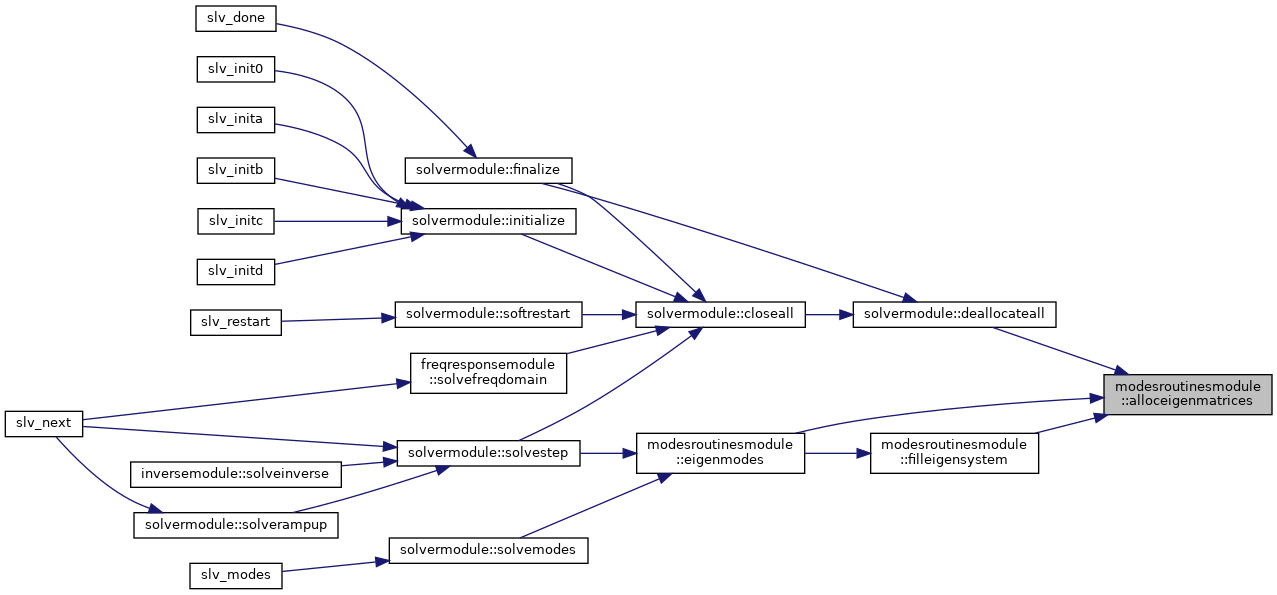
Allocates internal work arrays used by the eigenvalue solver.
- Parameters
-
modes Eigenmode data container [in] neq Number of equations, i.e., dimension of system matrices [in] neqEig Number of active equation during the eigenvalue analysis [out] ierr Error flag
◆ bubbelsort()
| subroutine modesroutinesmodule::bubbelsort | ( | real(dp), dimension(:), intent(in) | V, |
| integer, dimension(:), intent(inout) | ind | ||
| ) |
Sorts a real array in ascending order.
- Parameters
-
[in] V Array of real values to sort ind Array of indices defining the sorted order

◆ eigenmodes()
| subroutine, public modesroutinesmodule::eigenmodes | ( | type(samtype), intent(in) | sam, |
| type(modestype), intent(inout) | modes, | ||
| type(systemtype), intent(inout) | sys, | ||
| type(mechanismtype), intent(inout) | mech, | ||
| type(controltype), intent(inout) | ctrl, | ||
| type(controlstructtype), pointer | pCS, | ||
| integer, intent(in) | iprint, | ||
| integer, intent(out) | ierr | ||
| ) |
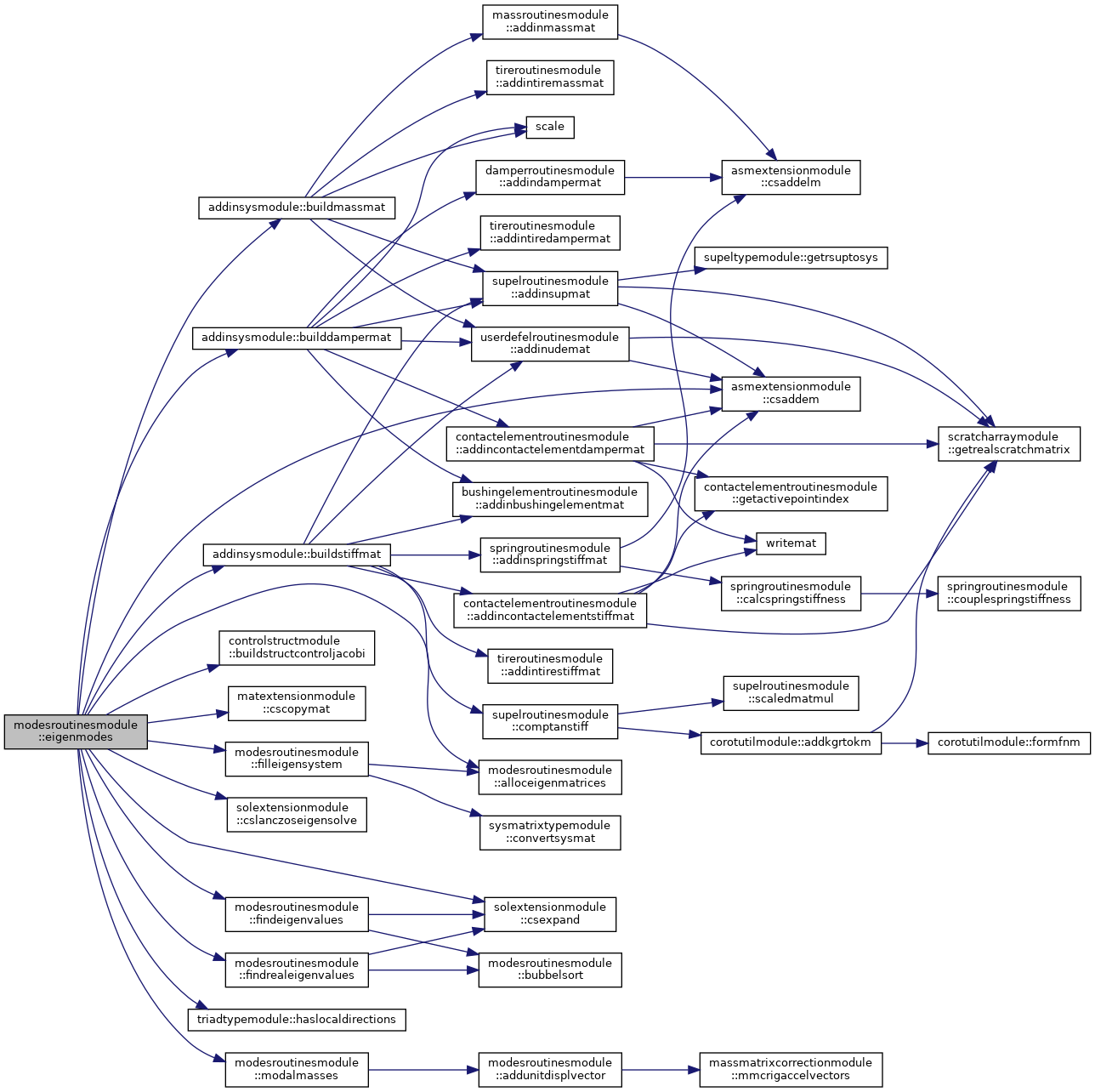
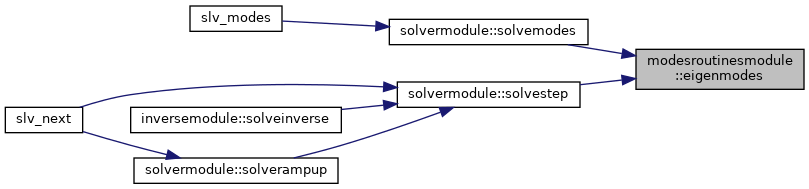
Calculates damped or undamped eigenvalues and eigenvectors.
- Parameters
-
[in] sam Data for managing system matrix assembly modes Eigenmode data sys System level model data mech Mechanism components of the model [in] ctrl Control system data pCS Data for coupled control system and structure modal analysis [in] iprint Print switch for additional output [out] ierr Error flag
This is the main driver of the system-level eigenvalue analysis. The parameter modestypemodule::modestype::solver determines which actual subroutine to be used, as follows:
- 0 : Use SPRLAN (undamped systems only)
- 1 : Use LANCZ1 (undamped systems only)
- 2 : Use LANCZ2 (undamped systems only)
- 3 : Use LAPACK::DGGEVX (undamped system)
- 4 : Use LAPACK::DGGEVX (damped system, 2n state-space form)
- 5 : Use LAPACK::DSYGVX (undamped, symmetric system)
- 6 : Use LAPACK::DGGEVX (3n state-space form)
◆ exportmodes()
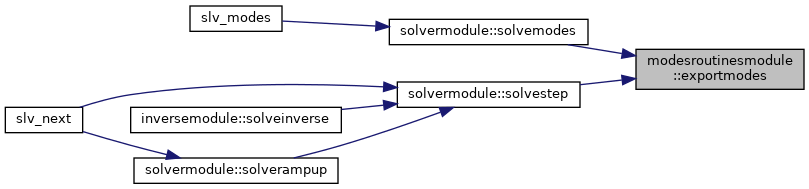
| subroutine, public modesroutinesmodule::exportmodes | ( | character(len=*), intent(in) | yamlFile, |
| character(len=*), intent(in) | modelFile, | ||
| type(modestype), intent(in) | modes, | ||
| type(triadtype), dimension(:), intent(inout) | triads, | ||
| type(supeltype), dimension(:), intent(inout) | sups, | ||
| integer(i8), intent(in) | iStep, | ||
| real(dp), intent(in) | time, | ||
| integer, intent(out) | ierr | ||
| ) |
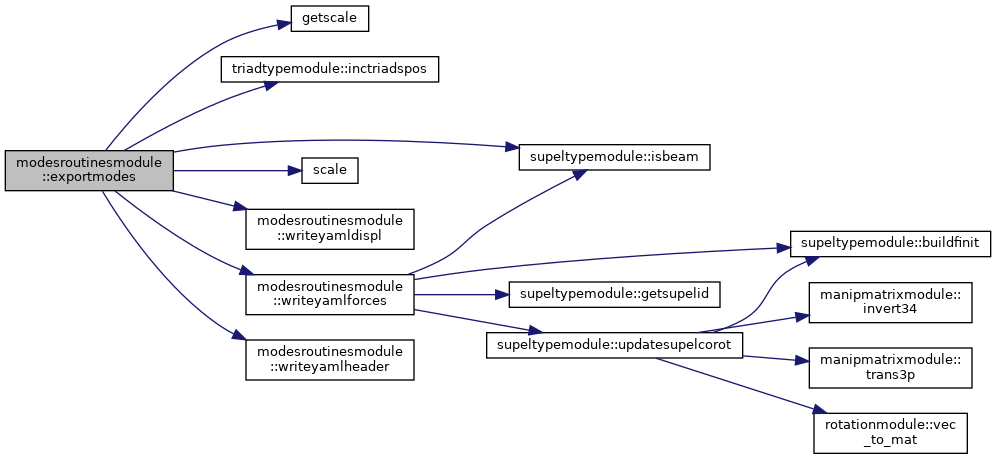
Exports mode shapes with associated beam section forces to YAML.
- Parameters
-
[in] yamlFile Name of the YAML-file top write [in] modelFile Name of the model file [in] modes Eigenmode data triads All triads in the model sups All superelements in the model [in] iStep Time increment counter [in] time Current simulation time [out] ierr Error flag
- Date
- 21 Jun 2017
◆ filleigensystem()
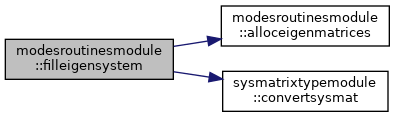
| subroutine modesroutinesmodule::filleigensystem | ( | type(modestype), intent(inout) | modes, |
| integer, intent(in) | neq, | ||
| type(sysmatrixtype), intent(in) | M, | ||
| type(sysmatrixtype), intent(in) | C, | ||
| type(sysmatrixtype), intent(in) | K, | ||
| type(sysmatrixtype), intent(in) | Q, | ||
| integer, intent(out) | ierr | ||
| ) |
Builds the full matrices of the generalized eigenvalue problem.
- Parameters
-
modes Eigenmode data container [in] neq Number of equations, i.e., dimension of system matrices [in] M System mass matrix [in] C System damping matrix [in] K System stiffness matrix [in] Q System steady-state error elimination matrix [out] ierr Error flag
The generalized eigenvalue problem is on the form A z = λ B z
Without damping:
[K]*{z} = lambda*[M]*{z}
With damping (2n state-space form):
     | K  0 |*{z} = lambda * | -C -M |*{z}
     | 0 -M |                | -M  0 |
With damping and/or steady-state error elimination (3n state-space form):
     | Q  0  0 |*{z} = lambda * | -K -C -M |*{z}
     | 0  K  0 |                |  K  0  0 |
     | 0  0  M |                |  0  M  0 |
- Note
- The 3n state-space method does not work quite yet. No eigenvalues are obtained for unknown reasons. However, the A and B matrices seems to be correct. The method has been proven valid in MATLAB. But the A and B matrices obtained through this code yield the same eigenvalue results in MATLAB. Can it be due to singular or very sparse matrices?
- Date
- 22 Mar 2000
- Date
- 8 Oct 2010

◆ findeigenvalues()
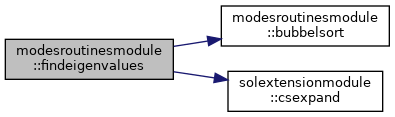
| subroutine modesroutinesmodule::findeigenvalues | ( | type(samtype), intent(in) | sam, |
| type(modestype), intent(inout) | modes, | ||
| integer, intent(in) | iprint, | ||
| integer, intent(in) | io, | ||
| integer, intent(out) | ierr | ||
| ) |
Extracts the complex eigenvalues and associated eigenvectors.
- Parameters
-
[in] sam Data for managing system matrix assembly modes Eigenmode data [in] iprint Print switch for additional output [in] io File unit number to write to [out] ierr Error flag

◆ findrealeigenvalues()
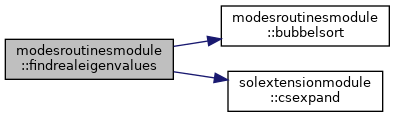
|
private |
Extracts the real eigenvalues and associated eigenvectors.
- Parameters
-
[in] sam Data for managing system matrix assembly modes Eigenmode data [out] normFactor Scaling factors for normalizing the eigenmode shapes [out] modeOrder Order of the modes with respect to eigenfrequency [in] iprint Print switch for additional output [in] io File unit number to write to [out] ierr Error flag

◆ modalmasses()
| subroutine modesroutinesmodule::modalmasses | ( | type(supeltype), dimension(:), intent(in) | sups, |
| type(modestype), intent(inout) | modes, | ||
| type(samtype), intent(in) | sam, | ||
| real(dp), dimension(:,:), intent(in) | eigVectors, | ||
| real(dp), dimension(:), intent(in) | normFactors, | ||
| integer, dimension(:), intent(in) | modeOrder, | ||
| integer, intent(out) | ierr | ||
| ) |
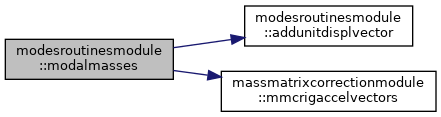
Calculates effective modal masses for the eigenmodes.
- Parameters
-
[in] sups All superelements in the model modes Eigenmode data [in] sam Data for managing system matrix assembly [in] eigVectors The eigenvectors [in] normFactors Scaling factors for normalizing the eigenmode shapes [in] modeOrder Order of the modes with respect to eigenfrequency [out] ierr Error flag
This subroutine is used to judge the significance of each vibration mode for each translation- and rotation component. Modes with relatively high effective masses can be readily excited by base exitation in the actual direction, while modes with lower effective masses may not be that critical. This is a commonly used feature, e.g. in NASTRAN.
The calculation is as follows:
[temp] = [Φ]^t[M]*[R]
M_eff(i,j) = temp(i,j)^2
where the eigenvector matrix, [Φ], is transposed and assumed to be mass-normalized, [M] is the compact mass matrix, and [R] is the influence matrix representing a rigid body unit displacement of the mechanism. Finally, [M_eff] is a nModes×6 matrix of the effective modal masses. The results are stored in the array modestypemodule::modestype::effmass.
- Todo:
- It works now for LANCZ2 and for the -undamped solvers (although I encountered something that looks like a bug in the -undamped calculation of the eigenvectors). Furthermore, local orientation of triads are not (yet) taken into account, but should normally not be critical as long as the local triad masses are the same in all coordinate directions (for inertias it will induce errors, however). Component modes seems to be treated correctly, but has not been tested too much. Some more elegance could also be put into the creation of unit displacement vectors, just to make sure that all kinds of joints and boundary conditions are treated correctly. In fact, there might be a better and easier solution to this than the approach I have used here.
- Date
- 2 Jul 2003

◆ printmodes()
| subroutine, public modesroutinesmodule::printmodes | ( | type(samtype), intent(in) | sam, |
| type(modestype), intent(in) | modes, | ||
| real(dp), intent(in) | time, | ||
| integer, intent(in) | iprint, | ||
| integer, intent(in) | io | ||
| ) |
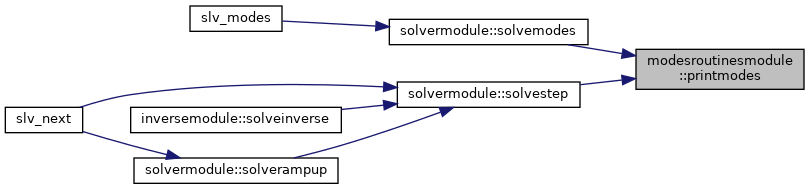
Prints the eigenvalues and eigenvectors to unit IO.
- Parameters
-
[in] sam Data for managing system matrix assembly modes Eigenmode data [in] time Current simulation time [in] iprint Print switch for additional output [in] io File unit number to write to
◆ writeyamldispl()
| subroutine modesroutinesmodule::writeyamldispl | ( | integer, intent(in) | iYaml, |
| type(triadtype), dimension(:), intent(in) | triads, | ||
| integer, intent(in) | iMod, | ||
| real(dp), intent(in) | eigVal, | ||
| real(dp), dimension(:), intent(in) | eigVec | ||
| ) |
Writes the mode shape eigenvector to a YAML frequency response file.
- Parameters
-
[in] iYaml File unit number of the YAML-file to write [in] triads All triads in the model [in] iMod Mode shape index [in] eigVal Associated eigenvalue [in] eigVec Associated eigenvector
- Date
- 21 Jun 2017

◆ writeyamlforces()
| subroutine modesroutinesmodule::writeyamlforces | ( | integer, intent(in) | iYaml, |
| type(supeltype), dimension(:), intent(inout) | sups, | ||
| real(dp), intent(in) | eigScale, | ||
| integer, intent(in) | iDbg, | ||
| integer, intent(out) | ierr | ||
| ) |
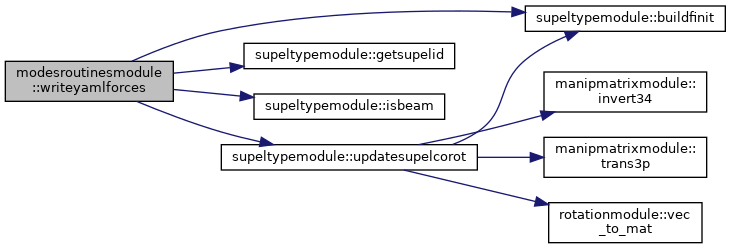
Writes beam sectional forces to a YAML frequency response file.
- Parameters
-
[in] iYaml File unit number of the YAML-file to write sups All superelements in the model [in] eigScale Scaling factor for the eigenvector [in] iDbg File unit number for debug output [in] ierr Error flag
- Date
- 21 Jun 2017

◆ writeyamlheader()
|
private |
Writes the header of a YAML frequency response file.
- Parameters
-
[in] iYaml File unit number of the YAML-file to write [in] prog Program name [in] modelFile Name of the model file [in] iStep Time increment counter [in] time Current simulation time
- Date
- 21 Jun 2017